
Weight loss that actually works is usually much less dramatic than social media makes it look.
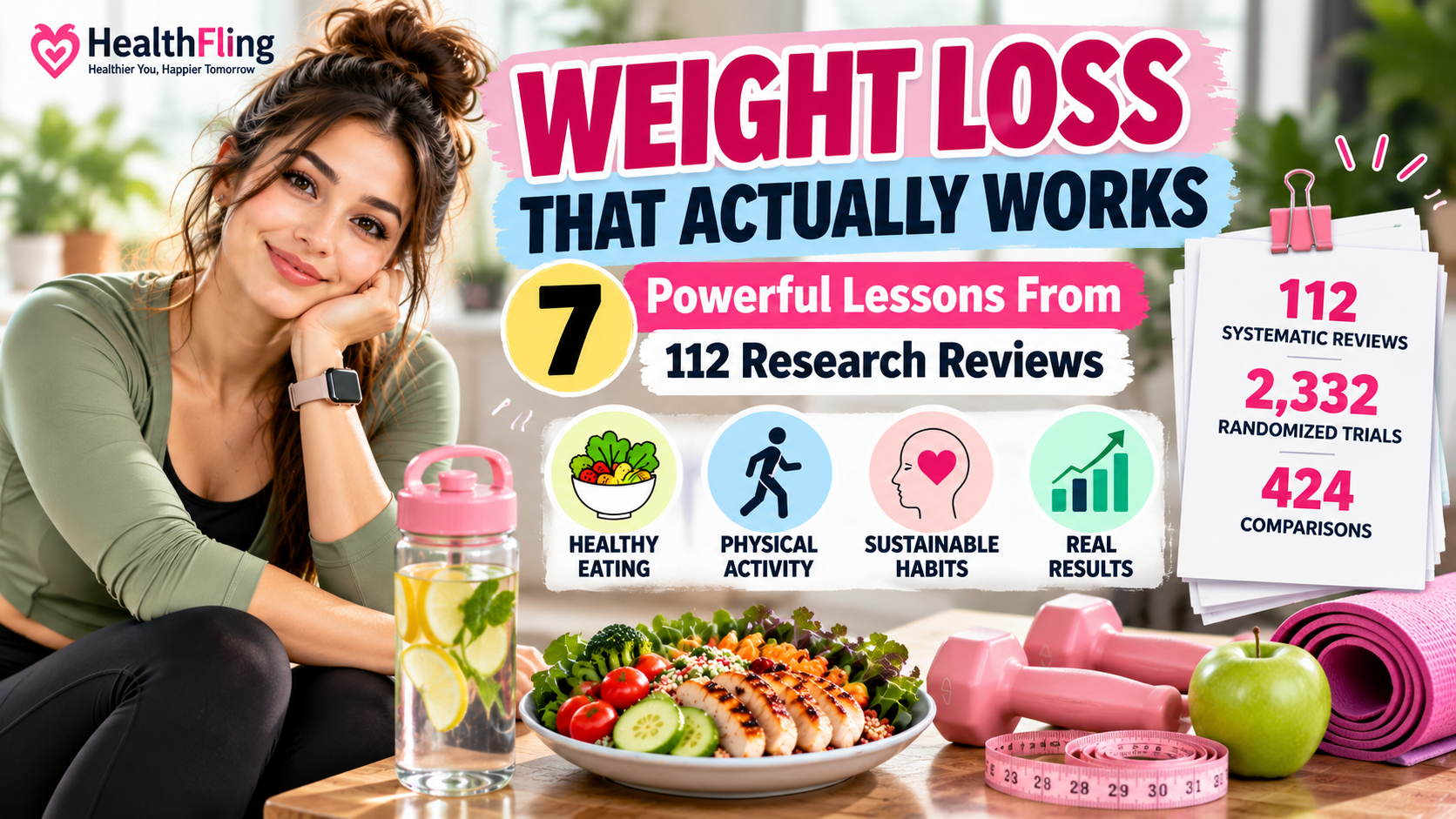
A major 2026 umbrella review brought together 112 systematic reviews and meta-analyses covering 424 comparisons and 2,332 unique randomized controlled trials involving adults with overweight or obesity.
The big message was not that researchers had discovered one perfect diet or one miracle workout. Instead, diet, physical activity and broader lifestyle approaches all produced meaningful but generally modest improvements — and combining healthier eating with physical activity appeared to produce the strongest overall long-term pattern.
For anyone tired of extreme plans, that matters. Weight loss that actually works may be less about doing everything perfectly and more about building several useful habits that you can repeat consistently.
7 Powerful Lessons About Weight Loss That Actually Works
1. Weight Loss That Actually Works Is Usually Modest
One of the clearest lessons from the umbrella review is that realistic weight loss is often smaller than the dramatic transformations people see online.
Across different types of dietary, physical-activity and lifestyle interventions, average reductions in body weight and BMI were generally modest.
That does not mean these approaches failed.
Small changes can still matter, especially when they are maintained over time and are accompanied by improvements in blood pressure, glucose control, fitness or other health measures.
The CDC’s healthy weight guidance also emphasizes gradual, sustainable lifestyle changes rather than quick fixes.
The practical lesson is simple: instead of asking how much weight you can lose as quickly as possible, ask whether your eating and activity pattern is something you can realistically maintain.
For many people, weight loss that actually works is slower, steadier and less extreme than the latest viral diet challenge.
2. Diet and Physical Activity Appear Stronger Together
The researchers compared dietary interventions, physical activity, lifestyle approaches and combinations of these strategies.
Among the findings, combined diet plus physical activity produced the largest average weight reduction beyond 12 months: approximately 3.68 kg more than control conditions.
However, that number needs context. The estimate came from a single contributing review, so it should not be treated as a prediction that every person following diet and exercise changes will lose exactly 3.68 kg.
The broader pattern is more useful: healthier eating and movement can complement each other.
For example, a realistic plan might include:
- Building meals around protein, vegetables and fiber-rich foods
- Reducing high-calorie drinks
- Walking more during the day
- Adding planned exercise when practical
- Keeping portions appropriate for your needs
- Improving sleep and daily routines
This is one reason weight loss that actually works often combines nutrition and movement instead of depending on either one alone.
3. Exercise Can Help Even When the Scale Moves Slowly
Many people become discouraged with exercise because their weight does not change as quickly as expected.
The umbrella review shows why judging exercise only by the scale can be misleading.
Physical activity was associated with meaningful cardiometabolic improvements even when weight changes were not dramatic.
At 6 to 12 months, physical-activity interventions showed the largest average reduction in systolic blood pressure among the intervention categories analyzed — about 6.10 mm Hg.
This does not mean every person who begins exercising will experience exactly that reduction.
It does reinforce an important point: physical activity is valuable for more than calorie burning.
Walking, resistance training and other forms of regular movement can support fitness, cardiovascular health, strength, sleep and long-term weight management.
If walking is your preferred starting point, read HealthFling’s Walking for Weight Loss guide.
Daily movement is another practical part of weight loss that actually works over the long term.
4. You Do Not Need One Perfect Diet
The umbrella review did not identify one branded diet as the universal solution.
That is useful context because weight-loss discussions often become arguments about which diet is supposedly best:
- Low carbohydrate
- Low fat
- Mediterranean-style eating
- High protein
- Intermittent fasting
- Plant-forward eating
The larger evidence base suggests that successful weight management is less about choosing the perfect diet label and more about finding a nutritionally reasonable eating pattern that helps control energy intake and that you can continue.
The NHS guidance on overweight and obesity similarly focuses on healthier eating, appropriate calorie reduction and increasing physical activity rather than promoting one miracle diet.
In everyday life, that can mean:
- Eating more vegetables and fruit
- Including protein in meals
- Choosing fiber-rich carbohydrates
- Reducing frequent high-calorie extras
- Drinking fewer sugary beverages
- Paying attention to portion sizes
- Choosing meals you genuinely enjoy
For many people, weight loss that actually works comes from an eating pattern they can sustain rather than the most restrictive diet available.
5. Health Improvement Is Not Only About Body Weight
One of the most useful findings from the new review is that some cardiometabolic improvements appeared partly independent of the amount of weight lost.
That means healthier eating and physical activity may benefit health even when someone does not reach a conventional target such as losing 5% to 10% of body weight.
This does not mean body weight is irrelevant.
It means weight is only one measure of progress.
Other useful indicators can include:
- Blood pressure
- Blood glucose
- Fitness
- Strength
- Walking endurance
- Waist measurement
- Sleep quality
- Daily movement
- Consistency with healthier eating
This is especially important for people who make meaningful lifestyle changes but feel discouraged because their scale moves slowly.
Weight loss that actually works should support overall health rather than turn one number on the scale into the only definition of success.
6. More Aggressive Does Not Always Mean More Effective
The review also helps put extreme weight-loss claims into perspective.
When thousands of randomized trials collectively tend to produce modest average weight changes, claims that one food, drink, supplement or seven-day routine will create massive lasting fat loss deserve skepticism.
Highly restrictive plans may sometimes produce rapid short-term changes.
But rapid change and sustainable change are not the same thing.
Individual progress can also vary because of factors such as:
- Starting body weight
- Age
- Activity level
- Sleep
- Stress
- Medications
- Medical conditions
- Genetics
- Food environment
A practical plan needs to work within real life instead of pretending these factors do not exist.
7. The Best Plan Is One You Can Keep Doing
The research does not give readers one magical meal plan.
Instead, it supports a more realistic approach: several evidence-based behaviors working together over time.
For most adults, that could look like the following.
Step 1: Understand Your Starting Point
Consider how much you currently eat, how active you are and which habits may be making weight management harder.
You do not necessarily have to track every calorie forever.
But understanding your approximate energy needs can make portion decisions easier.
Adult readers can use HealthFling’s Calorie Calculator for a general estimate.
Step 2: Build More Satisfying Meals
Meals containing protein, vegetables or fruit and fiber-rich foods can be easier to build around than highly restrictive rules.
If protein planning is useful for you, try HealthFling’s Protein Calculator.
The goal is not to maximize protein at every opportunity. It is to create balanced meals that fit your overall calorie and nutritional needs.
Step 3: Move More in a Way You Can Repeat
Walking is one of the simplest ways to increase daily movement.
You can begin with shorter walks and gradually increase duration, pace or daily steps according to your fitness level.
You do not need to turn every session into an exhausting workout.
Consistency often matters more than trying to make every workout extreme.
Weight loss that actually works usually benefits from movement you can keep doing week after week.
Step 4: Add Structure Without Changing Everything at Once
Instead of trying to rebuild your entire lifestyle on Monday morning, choose a few repeatable habits.
Examples include:
- Eating a protein-rich breakfast
- Taking a short walk after lunch
- Replacing one sugary drink with water
- Adding vegetables to dinner
- Preparing tomorrow’s lunch the night before
- Creating a regular sleep routine
HealthFling’s 30-Day HealthFling Journey is designed around gradual habit-building rather than extreme overnight changes.
Step 5: Measure More Than Body Weight
Depending on your goals and health situation, you may also want to monitor:
- Walking time
- Daily steps
- Strength
- Waist measurement
- Energy levels
- Sleep consistency
- Eating habits
- Blood pressure when medically appropriate
This gives you more than one way to recognize progress.
What 112 Reviews Say About Weight Loss That Actually Works
The new research was an umbrella review and meta-analysis.
An umbrella review does not recruit one new group of participants. Instead, researchers collect and evaluate existing systematic reviews and meta-analyses to understand the broader evidence.
In this case, researchers searched evidence published from 2015 through 2025.
They included:
- 112 systematic reviews and meta-analyses
- 424 comparisons
- 2,332 unique randomized controlled trials
- Evidence spanning more than 50 countries
The researchers compared changes in weight, BMI and cardiometabolic outcomes across different intervention types and follow-up periods.
You can read the PubMed record for the umbrella review.
The full open-access research paper is available through ScienceDirect.
Important Limitations of the Research
A study combining 112 reviews sounds enormous, but size alone does not remove uncertainty.
The researchers reported high heterogeneity across many analyses.
In simple terms, the included studies often differed in their participants, intervention designs, follow-up periods and methodology.
The authors also reported that approximately 69% of included reviews were rated as low or critically low confidence using the AMSTAR 2 quality-assessment tool.
Some findings were based on relatively limited contributing evidence.
For example, the reported 3.68 kg long-term advantage for combined diet plus physical activity came from one contributing review.
So this research gives us useful overall direction, but it cannot tell an individual person exactly how much weight they will lose.
That distinction is important when talking about weight loss that actually works: population averages are not personal guarantees.
What Current Health Guidance Says
The overall message is broadly consistent with current public-health guidance.
The CDC describes healthy weight management as involving nutritious eating, regular physical activity, enough sleep and stress management.
The NHS also emphasizes healthier eating, calorie awareness and physical activity for people trying to manage excess weight.
Neither approach depends on one miracle food, one special drink or one short-term challenge.
Frequently Asked Questions About Weight Loss That Actually Works
What is weight loss that actually works?
Weight loss that actually works generally involves sustainable changes to eating, physical activity and other lifestyle behaviors that help create an appropriate calorie deficit and can be maintained over time.
Did the new research prove diet and exercise are the best way to lose weight?
The umbrella review found that combined diet and physical activity produced the strongest overall long-term weight-loss pattern among the categories analyzed.
However, evidence quality varied, and some specific estimates were based on limited contributing reviews.
How many studies were included?
The researchers included 112 systematic reviews and meta-analyses containing 2,332 unique randomized controlled trials and 424 comparisons.
Does exercise still help if I am not losing much weight?
Yes. Physical activity can provide important health benefits even when weight changes are modest.
The umbrella review found meaningful improvements in cardiometabolic outcomes, including blood-pressure changes.
Is a small amount of weight loss worth it?
Potentially, yes. Health improvements do not always require dramatic weight loss, and healthier eating and physical activity can provide benefits beyond changes on the scale.
Do I have to count calories?
Not necessarily forever.
However, understanding approximate calorie intake and portion sizes can help explain weight trends and make everyday food decisions easier.
Is there one best diet for weight loss?
No single eating pattern is ideal for every person.
The most useful approach is usually one that supports appropriate calorie intake, adequate nutrition and long-term adherence.
The Bottom Line
The biggest lesson from 112 research reviews is not that scientists discovered a secret new diet.
It is almost the opposite.
The evidence suggests that weight loss that actually works is usually built from several ordinary behaviors working together:
- Healthier eating
- Regular physical activity
- Realistic calorie awareness
- Consistent habits
- A plan you can maintain
The research also reminds us that the scale is not the only useful measure of success.
Better fitness, blood pressure, glucose control, sleep and daily activity can all represent meaningful progress.
Instead of searching for the fastest possible method, ask a more useful question:
What healthy changes can I realistically still be doing six months from now?
That is often where weight loss that actually works begins.
Medical disclaimer: This article is for general educational purposes only and is not a substitute for individualized medical advice. People with medical conditions, pregnancy, a history of eating disorders, or concerns about their weight, medications or exercise should speak with an appropriately qualified healthcare professional before making major changes to diet or activity.