
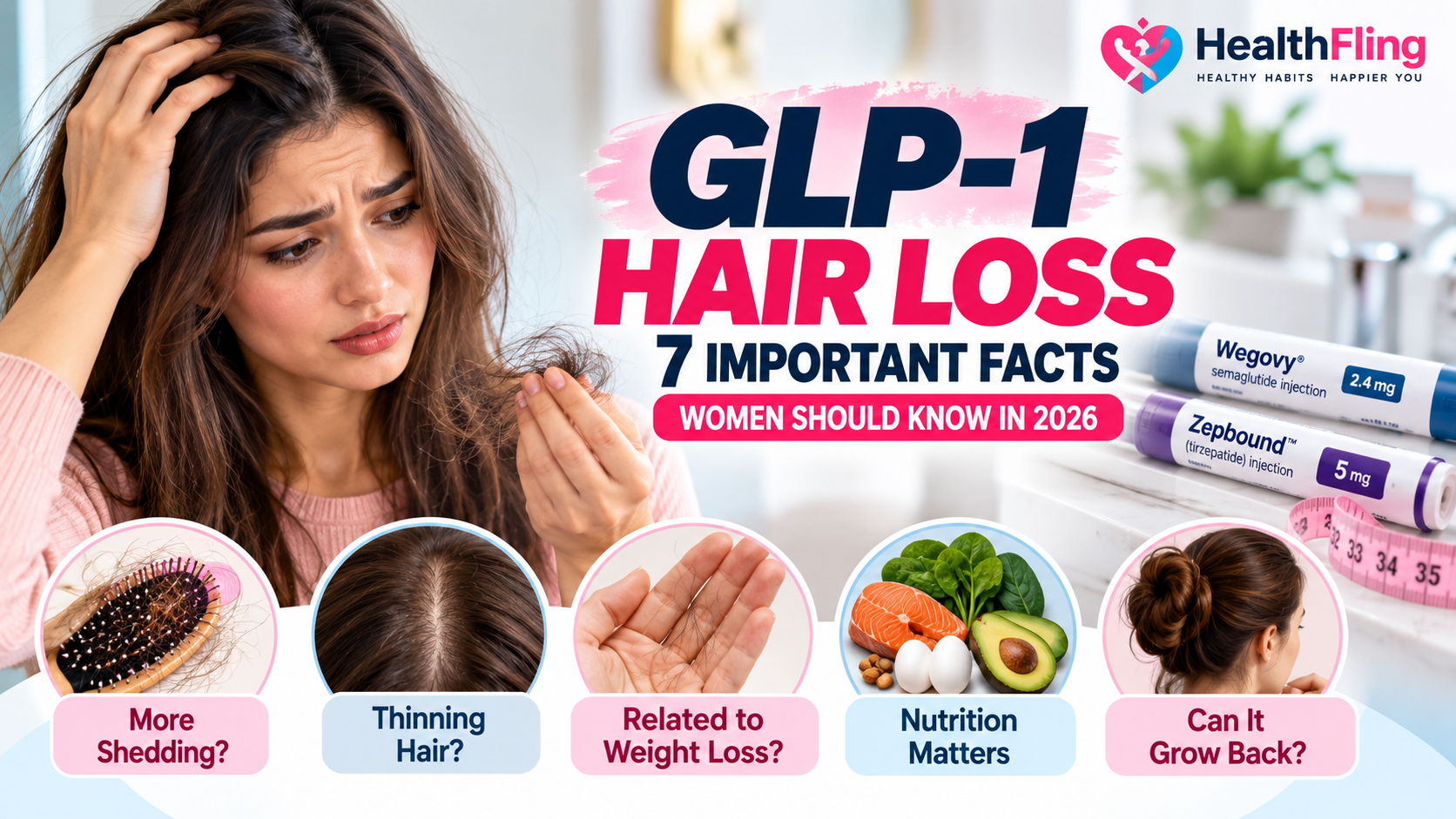
GLP-1 Hair Loss: 7 Important Facts Women Should Know in 2026
GLP-1 hair loss is becoming one of the most talked-about concerns among people using medicines such as semaglutide and tirzepatide for weight management.
Some people notice more strands in the shower.
Others see their ponytail becoming thinner or their part looking wider.
And women, in particular, may be paying closer attention because hair loss was reported more often among female participants than male participants in some major weight-loss drug trials.
Fresh 2026 research is now giving us a clearer picture.
A systematic review and meta-analysis published in Diabetes Research and Clinical Practice analyzed nine interventional studies involving 4,114 GLP-1 receptor agonist users. Researchers found a significantly higher risk of hair loss among GLP-1 users compared with placebo, with an overall hair-loss event rate of about 3.9%. ScienceDirect
That does not mean everyone who takes a GLP-1 medicine will lose hair.
It also does not prove that the medicine itself is always the direct cause.
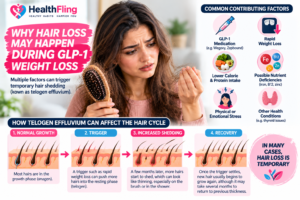
Rapid weight loss, reduced calorie intake, lower protein intake, nutrient deficiencies, stress on the body and individual susceptibility may all contribute.
Here are 7 important things women should know about GLP-1 hair loss in 2026.
Does GLP-1 Hair Loss Really Happen?
Yes, hair loss has been reported in clinical trials and recent research involving some GLP-1-based weight-loss medicines. However, researchers are still working out how much is caused directly by the medication and how much may result from rapid weight loss, lower food intake, nutritional changes or temporary telogen effluvium.
That distinction matters.
The American Academy of Dermatology says people taking GLP-1 medicines may experience thinning hair and explains that dermatologists believe sudden weight loss may contribute through a temporary shedding condition known as telogen effluvium.
The AAD also notes that eating less may reduce intake of protein, vitamins and other nutrients needed for normal hair growth. AAD
So the answer is not simply:
“GLP-1 drugs directly destroy hair.”
The biology appears more complicated.
1. New 2026 Research Found a Real Hair-Loss Signal
One of the strongest pieces of recent evidence comes from the 2026 meta-analysis involving 4,114 GLP-1 users.
Researchers included:
- 7 randomized controlled trials
- 2 prospective non-randomized studies
The pooled analysis found that people receiving GLP-1 receptor agonists had a higher reported risk of hair loss compared with placebo.
The estimated hair-loss event rate among GLP-1 users was approximately 3.9%. ScienceDirect
The researchers specifically identified signals involving semaglutide and tirzepatide.
That makes GLP-1 hair loss more than just a collection of social-media anecdotes.
But the finding still needs perspective.
Most people in these studies did not report hair loss.
And an association does not automatically establish the exact biological cause.
This is why researchers continue to investigate whether the primary trigger is:
rapid weight loss,
reduced nutrition,
the medication itself,
or some combination of these factors.
2. Hair Loss Was Reported More Often in Women in Major Trials
This is especially relevant to HealthFling’s female readers.
Official U.S. prescribing information for Wegovy reports that in pooled studies using the 2.4 mg injection, hair loss occurred in 3.3% of Wegovy-treated participants compared with 1% receiving placebo.
When broken down by sex, the label reports hair loss in approximately 4% of women versus 0.9% of men receiving Wegovy 2.4 mg.
The prescribing information states that these hair-loss adverse reactions were associated with weight reduction. FDA Access Data
The pattern is also visible with tirzepatide.
Official Zepbound prescribing information reports hair loss in 7.1% of female patients versus 0.5% of male patients receiving Zepbound in pooled trials.
Among placebo participants, the figures were 1.3% in women and 0% in men.
Again, the label specifically notes that hair loss was associated with weight reduction. Lilly PI
This does not prove that every woman has a higher biological susceptibility.
Trial populations and other factors can influence these numbers.
But it does explain why GLP-1 hair loss in women deserves specific attention.
3. Rapid Weight Loss May Be a Major Part of the Explanation
One likely explanation is a condition called telogen effluvium.
Telogen effluvium is a temporary form of excessive hair shedding that can occur after the body goes through a significant physical or emotional change.
The British Association of Dermatologists lists marked weight loss and extreme dieting among recognized triggers.
The shedding often becomes noticeable around several months after the trigger because of the way the normal hair-growth cycle works. Bad
This creates an important timing issue.
Someone may start a GLP-1 medicine, lose a substantial amount of weight, and then notice increased shedding weeks or months later.
It can be easy to assume:
“The injection suddenly damaged my hair.”
But in some cases, the shedding may represent the body’s delayed response to major weight loss or nutritional change.
The American Academy of Dermatology similarly says sudden weight loss from GLP-1 treatment may trigger telogen effluvium. AAD
4. Eating Much Less Can Affect Hair Nutrition
GLP-1 medicines can reduce appetite substantially.
That can be helpful for weight management.
But eating considerably less also means there is less room for nutritional mistakes.
Hair follicles need energy, protein and micronutrients to support normal growth.
If someone dramatically cuts food intake without planning meals carefully, their intake of nutrients such as:
- protein
- iron
- zinc
- vitamin B12
- folate
- essential fatty acids
may become inadequate.
The American Academy of Dermatology notes that insufficient protein or iron intake can contribute to hair loss and that eating too few calories can also cause significant shedding. AAD
That does not mean everyone taking a GLP-1 needs a cabinet full of hair supplements.
In fact, taking excessive amounts of some nutrients can itself worsen hair loss.
A better strategy is to focus first on a balanced diet and investigate deficiencies when medically appropriate.
If you are trying to maintain adequate protein while losing weight, the HealthFling Protein Calculator can provide a general educational estimate.
You can also read Protein Timing for Weight Loss for practical ideas on spreading protein across the day.
5. Real-World Users Are Reporting Shedding and Thinning
Clinical trials are not the only source of evidence.
A 2026 U.S. cross-sectional survey of 504 GLP-1 users examined hair, skin and quality-of-life changes during treatment.
The group was predominantly female — approximately 89.9% women.
Overall, 38.9% reported some type of hair change, including increased shedding, thinning, dryness or breakage.
Increased shedding was reported by 20.8% and thinning by 19%.
The researchers also observed that hair changes were more common among people who had lost larger amounts of weight. Wiley Online Library
But there is an important limitation.
This was a survey based largely on self-reported experiences.
It cannot prove that GLP-1 medication directly caused each reported hair change.
Its percentages should therefore not be interpreted as the expected incidence for every GLP-1 user.
What it does show is that hair concerns are significant enough in real-world patients to deserve proper research and clinical attention.
6. GLP-1 Hair Loss May Be Temporary for Some People
If the shedding is telogen effluvium caused by rapid weight loss or another temporary physiological stress, there is some reassuring news.
The British Association of Dermatologists says telogen effluvium usually improves without specific treatment once the underlying trigger has resolved.
Its patient guidance says the shedding phase often lasts around three to six months, after which new hair begins growing, although returning to previous thickness can take longer. Bad
However, you should not assume every case of GLP-1 hair loss is telogen effluvium.
Other causes can include:
- iron deficiency
- thyroid disorders
- female-pattern hair loss
- alopecia areata
- hormonal changes
- other medicines
- illness
- significant stress
Sometimes more than one condition is present at the same time.
That is why diagnosis matters.
A dermatologist can help distinguish temporary diffuse shedding from other forms of hair loss that may require different treatment.
7. Do Not Stop a GLP-1 Medicine on Your Own Because of Hair Loss
Seeing significant hair shedding can be frightening.
But stopping a prescription medicine suddenly without speaking with the clinician who prescribed it is not the best first step.
Hair loss can have many causes.
And the correct response depends on:
- the type of hair loss
- how rapidly weight is changing
- overall calorie intake
- protein intake
- iron status
- thyroid health
- other medications
- underlying hair conditions
- benefits you are getting from treatment
The American Academy of Dermatology recommends working with a dermatologist to identify the specific type of hair loss and coordinate care when someone is taking a GLP-1 medicine. AAD
If you are experiencing new or worsening shedding, speak with your prescriber before changing your dose or discontinuing treatment.
What Should You Do If Your Hair Starts Shedding on a GLP-1?
Start by looking at the bigger picture.
Speak With Your Prescriber
Tell the clinician managing your treatment when the shedding began and how quickly you have been losing weight.
Do not assume hair loss is something you simply have to tolerate.
Consider a Dermatology Evaluation
A dermatologist can determine whether the pattern looks like telogen effluvium, female-pattern hair loss, alopecia areata or another condition.
The British Association of Dermatologists notes that doctors may sometimes use blood tests to investigate other possible causes, such as thyroid disease or iron deficiency. Bad
Review Your Food Intake
Reduced appetite can make it surprisingly easy to under-eat.
Instead of trying to consume as little food as possible, focus on making the food you do eat nutritionally useful.
Include appropriate sources of:
protein,
vegetables,
fruit,
whole grains,
healthy fats,
and iron-rich foods.
The HealthFling Calorie Calculator can give you a general estimate of energy needs, while the Protein Calculator can help you understand a general protein range.
Neither tool replaces personalized advice from your healthcare professional.
Avoid Extreme Dieting
A GLP-1 already reduces appetite for many people.
Adding an extremely restrictive crash diet may increase the chance that nutrition becomes inadequate.
Sustainable weight loss remains the better long-term target.
The HealthFling 30-Day Journey focuses on realistic habits instead of extreme short-term rules.
Treat Your Hair Gently
If you are already shedding more than usual, avoid unnecessary stress on the hair.
The British Association of Dermatologists recommends avoiding harsh brushing, frequent heat styling, harsh chemical treatments and tight hairstyles when dealing with telogen effluvium. Bad
What About Hair-Growth Vitamins and Supplements?
This is where social media can become risky.
After seeing hair shedding, people may immediately order:
biotin gummies,
iron tablets,
zinc,
selenium,
vitamin A,
or multiple “hair-growth” supplements.
More is not always better.
The American Academy of Dermatology warns that excessive amounts of certain nutrients — including selenium, vitamin A and vitamin E — can actually contribute to hair loss. AAD
If you suspect a deficiency, it is better to discuss testing with a healthcare professional than to take high-dose supplements blindly.
Does Wegovy Cause Hair Loss?
Hair loss is included in current Wegovy prescribing information.
In pooled weight-reduction trials of Wegovy 2.4 mg, hair loss was reported more often with Wegovy than with placebo, and it was reported more frequently among female participants.
The label notes that hair-loss reactions were associated with weight reduction. FDA Access Data
That means the most accurate answer is:
Wegovy treatment is associated with reported hair loss, but the degree to which semaglutide itself versus weight loss and related physiological changes causes the shedding remains under investigation.
Does Zepbound Cause Hair Loss?
Hair loss is also listed among adverse reactions in Zepbound prescribing information.
In pooled trials, hair loss occurred substantially more often among female Zepbound participants than male participants, and the prescribing information also describes the hair-loss reactions as associated with weight reduction. Lilly PI
Again, that is an association.
It does not prove that tirzepatide directly damages hair follicles.
Is GLP-1 Hair Loss Different From Permanent Baldness?
Often, yes.
Telogen effluvium typically causes diffuse shedding across the scalp rather than isolated bald patches.
People may notice:
more hair in the shower,
more strands on the brush,
a smaller ponytail,
or reduced overall volume.
The British Association of Dermatologists explains that telogen effluvium usually resolves once the trigger settles, although regrowth takes time. Bad
But not every case is telogen effluvium.
A widening part, patterned thinning, smooth bald patches, scalp inflammation or persistent shedding deserves professional evaluation.
Frequently Asked Questions About GLP-1 Hair Loss
Is GLP-1 Hair Loss Common?
Recent studies suggest hair loss is a genuine adverse-effect signal, but it still affects a minority of participants in controlled trials.
A 2026 meta-analysis reported an overall hair-loss event rate of approximately 3.9% among GLP-1 users included in its studies. PubMed
Why Do Women Seem to Report More Hair Loss?
Official Wegovy and Zepbound trial data reported higher hair-loss percentages among women than men.
However, researchers have not established that sex alone is the cause.
Differences in trial populations, hormones, hair biology, weight-loss magnitude and reporting may all contribute. FDA Access Data
When Can Hair Shedding Start?
If the cause is telogen effluvium, increased shedding may become noticeable a few months after a major trigger such as marked weight loss.
Some GLP-1 users report changes earlier, but timing varies considerably. Bad
Will Hair Grow Back?
When shedding is caused by temporary telogen effluvium and the trigger has resolved, hair usually begins to grow again.
It may still take many months for the hair to regain its previous volume.
Other types of hair loss may behave differently. Bad
Should I Stop Wegovy or Zepbound if My Hair Is Falling Out?
Do not stop or change a prescription medicine solely on the basis of an online article.
Contact the clinician who prescribed it and discuss the severity of the shedding, your rate of weight loss, nutrition and other possible causes.
Can Eating More Protein Stop GLP-1 Hair Loss?
Adequate protein is important for normal hair health, but protein alone cannot prevent every type of hair loss.
If intake is low, improving nutrition may help address one potential contributing factor.
Use the HealthFling Protein Calculator as a general educational starting point.
Should I Take Biotin?
Do not assume biotin or another supplement is necessary.
Hair loss has many causes, and excessive supplementation can sometimes create problems.
A clinician can help determine whether testing for specific nutritional deficiencies makes sense.
The Bottom Line
GLP-1 hair loss is a real research signal, but the story is more nuanced than viral headlines suggest.
Fresh 2026 evidence found a higher risk of hair loss among GLP-1 users compared with placebo, and official Wegovy and Zepbound prescribing information includes hair loss among reported adverse reactions. PubMed
Women had higher reported hair-loss rates than men in relevant weight-loss trials.
But researchers still have not fully separated the effects of the medicine itself from the effects of rapid weight loss, reduced calorie intake, nutritional changes and telogen effluvium.
If shedding develops:
do not panic, do not crash diet, do not start random high-dose supplements and do not stop prescription treatment without discussing it with your healthcare professional.
Instead, pay attention to nutrition, protein intake and the rate of weight loss, and consider medical or dermatology evaluation if shedding is substantial, persistent or unusual.
For more practical weight-management support, explore the HealthFling Free Tools and build habits you can actually maintain.
HealthFling provides general educational information and is not a substitute for medical diagnosis or individualized treatment. Speak with a qualified healthcare professional about medication side effects, significant hair loss, nutritional deficiencies or changes to prescribed GLP-1 treatment.
Research & Trusted Sources
2026 GLP-1 Hair Loss Meta-Analysis — PubMed
Open the PubMed study
2026 GLP-1 Hair Loss Meta-Analysis — Full journal record
Read the journal study
American Academy of Dermatology — GLP-1 effects on hair, skin and nails
Read dermatologist guidance
British Association of Dermatologists — Telogen Effluvium
Read the patient guidance
Official Wegovy Prescribing Information
View Wegovy prescribing information
Official Zepbound Prescribing Information
View Zepbound prescribing information