
Olivia watches the number on the scale fall, yet carrying groceries feels harder. In HealthFling’s fictional Reel, her friend Maya suggests looking beyond weight and asking about strength. That moment captures an understandable worry: what happens to the rest of your body while you lose fat?
Strength training during weight loss deserves attention alongside the scale. A new randomized trial offers encouraging evidence for people prescribed tirzepatide. Its message is specific: resistance exercise reduced lean soft tissue loss and improved measured strength. It did not prevent all lean tissue loss, and it cannot predict everyone’s results.
Olivia and Maya are fictional characters, not research participants. Feeling weak does not diagnose muscle loss; symptoms deserve individual assessment.
Why weight loss can include lean tissue
A calorie deficit means your body uses more energy than you consume. Fat supplies some of that energy, but weight changes can also include water and lean tissue. The amount varies with the person, the size of the energy shortfall, activity, nutrition, and the method of measurement. A falling scale cannot tell you which compartment changed.
This is one reason to consider how you function, rather than judging progress only by pounds lost. Can you get out of a chair comfortably? Are familiar exercises becoming easier? These observations can guide a conversation with your healthcare team, although they cannot replace a clinical assessment.
The NIH’s NIDDK guidance identifies muscle-strengthening activity as a way to support muscle maintenance during weight loss. For the energy-balance basics, see HealthFling’s calorie deficit guide; this article focuses on strength and the new medication-specific evidence.
What the new 2026 trial investigated
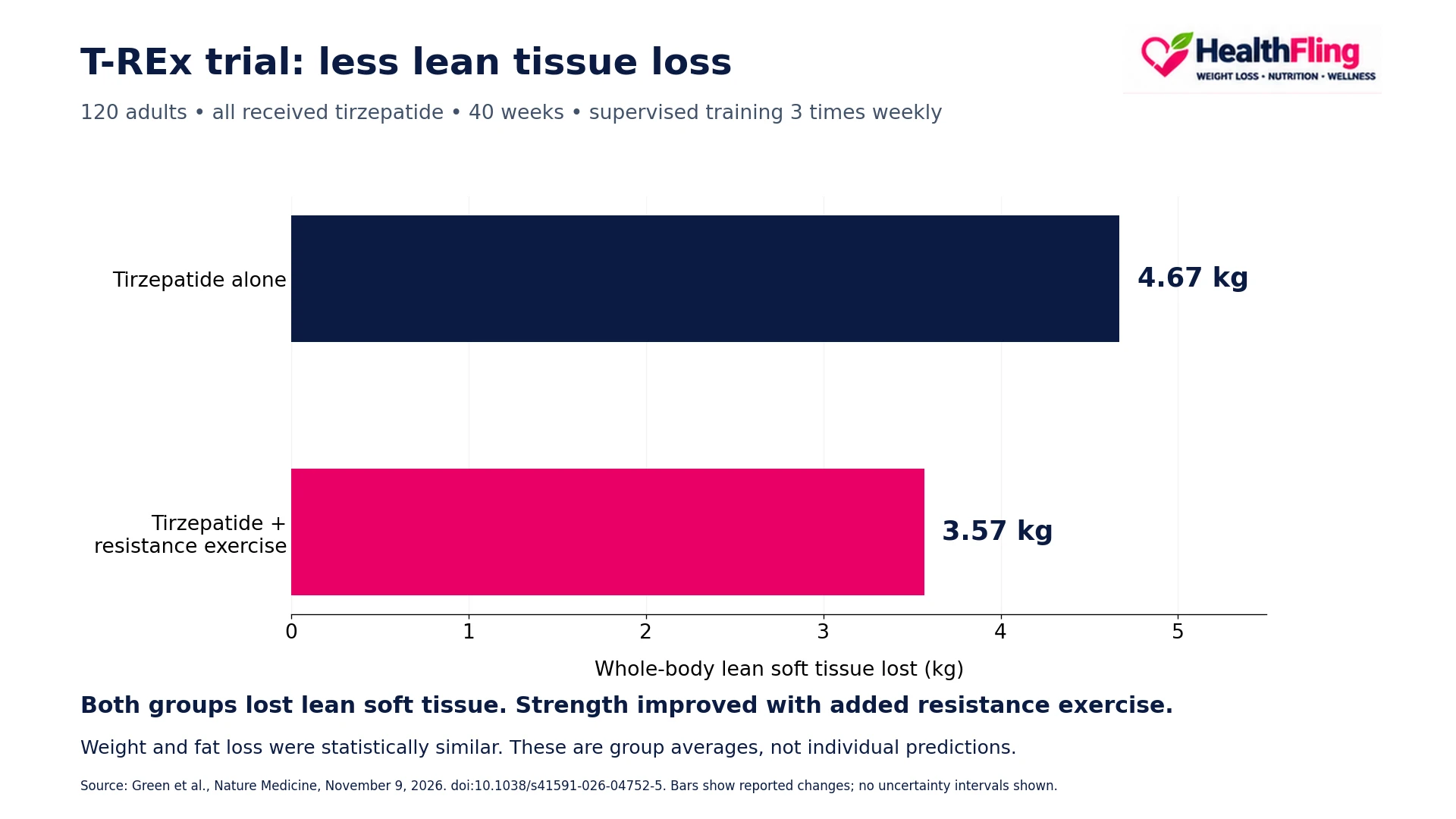
Published in Nature Medicine on November 9, 2026, the Tirzepatide and Resistance Exercise trial included 120 adults with overweight or obesity. Everyone received tirzepatide. Participants were randomly assigned to usual activities or supervised resistance training three times weekly for 40 weeks.
The single-center Australian study recruited relatively inactive adults aged 50–70, including men and postmenopausal women. It measured body composition using dual-energy X-ray absorptiometry, or DXA, alongside strength tests. This was a comparison of exercise added to medication—not medication versus exercise.
What the trial found about strength training during weight loss
Average weight loss was similar: 22.61 kg with tirzepatide alone and 22.28 kg with added training. Fat loss was also statistically similar. Whole-body lean soft tissue fell by 4.67 kg versus 3.57 kg, respectively; the reported between-group difference was about 1.09 kg. Strength decreased without training but increased with it.
The University of Western Australia’s research report describes high exercise attendance—91%—and improvements in both upper- and lower-body strength. That level of participation matters when interpreting what a structured program can achieve.
For example, bench-press strength changed by −4.09 kg with medication alone versus +4.68 kg with training. Lat-pulldown changes were −4.42 versus +8.58 kg; knee-extension changes were −4.42 versus +5.88 kg. These are changes on specific strength tests, not kilograms of muscle gained.
Better strength does not mean zero tissue loss
Both groups still lost lean soft tissue. The exercise group’s better strength outcomes therefore should not become a claim that training completely prevented muscle loss. Nor did the study establish that adding weights produces extra weight loss with tirzepatide.
For a reader following the Reel, the useful shift is from “How fast can I lose weight?” to “How can my treatment plan also support daily function?” A smaller waist and a stronger body are different outcomes; a sensible plan can monitor both.
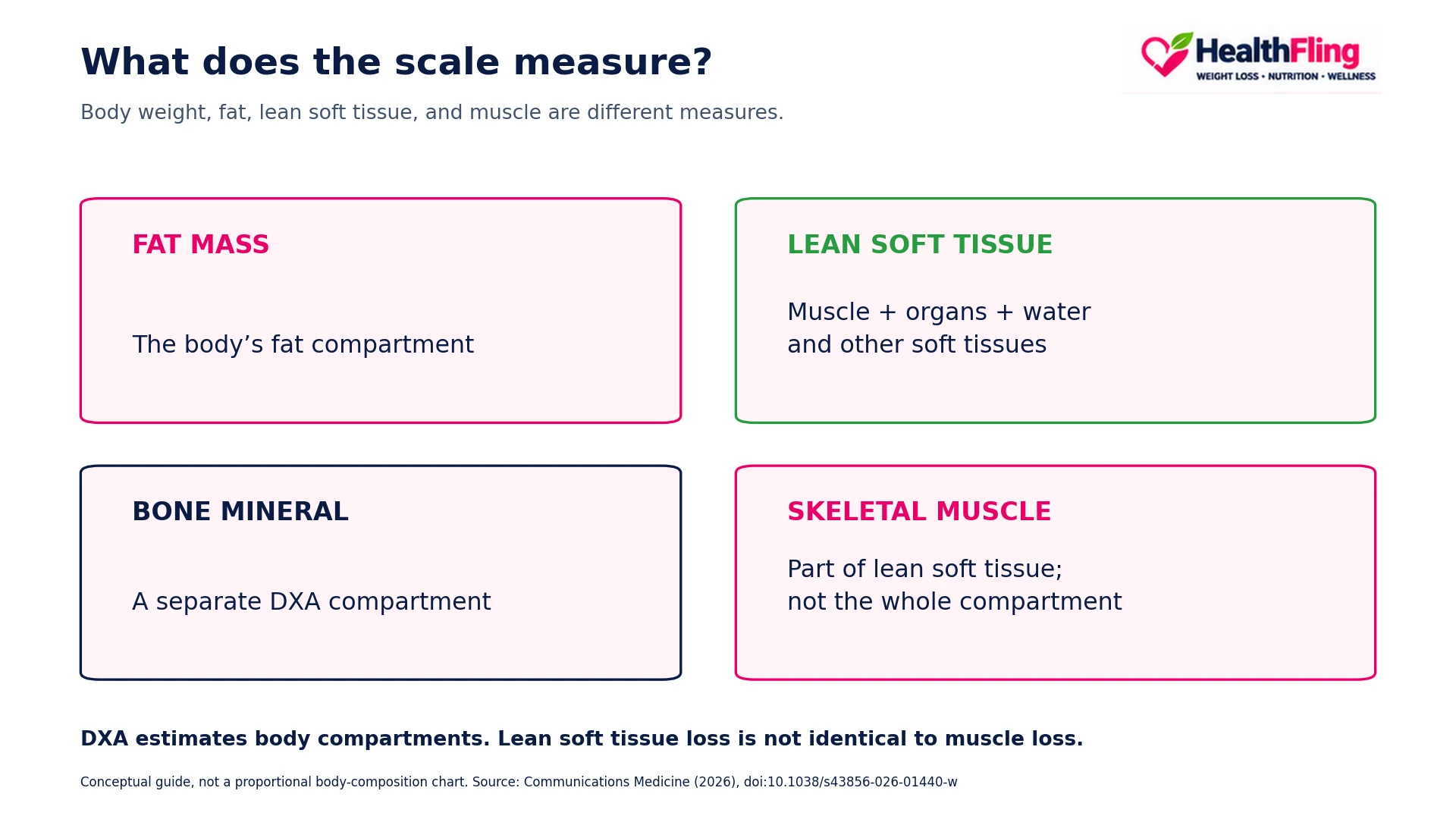
Body weight, fat mass, lean soft tissue, and muscle are different
- Body weight: everything the scale weighs, including tissues, water, and digestive contents.
- Fat mass: the body’s fat compartment estimated by a body-composition method.
- Lean soft tissue: non-fat, non-bone soft tissue, including muscle but also organs, water, and other tissues.
- Skeletal muscle: the muscles that help you move, only part of lean soft tissue.
Research comparing DXA with MRI explains why a DXA lean-tissue estimate should not be treated as a direct measurement of skeletal muscle. Different methods answer different questions. A reported loss of one kilogram of lean soft tissue is not automatically one kilogram of muscle.
Strength is another distinct measure: it reflects performance in a particular task. That distinction helps explain why interpreting a body-composition number without functional information can be misleading. Consumer scale estimates should likewise not be used to diagnose a muscle disorder.
Getting started with strength training during weight loss
Resistance training means making muscles work against a load. That load might be your body weight, a resistance band, a machine, or a dumbbell. You do not need to begin with heavy lifting, copy an influencer’s routine, or reproduce the trial’s supervised program on your own.
The CDC recommends muscle-strengthening activity on at least two days weekly, covering major muscle groups, alongside aerobic activity. Someone starting from very little activity can build gradually. These general guidelines are not a personalized exercise prescription.
An adaptable starter session
The following is an example to discuss with a qualified trainer, physiotherapist, or clinician when appropriate. Choose comfortable versions and a stable environment.
- Chair sit-to-stand: use a firm chair that cannot slide; use arm support if needed.
- Wall push-up: place hands on a wall and move slowly through a comfortable range.
- Supported row: use a light band with a secure anchor, or a suitable machine after instruction.
- Supported calf raise: hold a sturdy support and lift and lower your heels with control.
Warm up with several minutes of easy movement. Start with a manageable number of controlled repetitions rather than forcing a target. The NHS explains sets and repetitions and suggests working toward 8–12 repetitions per activity. Beginners may need fewer while learning technique.
Leave recovery time between sessions that work the same muscles. Keep breathing; do not hold your breath while straining. Stop an exercise if it causes sharp pain, dizziness, or unusual symptoms. Progress by improving control first, then gradually adjusting repetitions or resistance with guidance.

Make progress practical
Keep a short log: exercise, resistance, repetitions, and how it felt. Choose two realistic appointment-style slots in your week before adding more. A five-minute introduction may be more useful than an ambitious plan you abandon. Consistency should fit your circumstances and recovery.
Walking remains valuable aerobic activity, but it is not a complete substitute for progressive resistance work. HealthFling’s walking for weight loss guide covers that complementary habit. Avoid treating exercise as punishment for eating or using soreness as proof of a successful workout.
Nutrition and protein support the bigger plan
Exercise is only one part of maintaining physical function. If reduced appetite makes you eat very little, it can become difficult to meet nutritional needs. A joint advisory from four medical and nutrition organizations emphasizes nutrition assessment, adequate protein, and resistance exercise during GLP-1 treatment.
Protein-rich foods can include yogurt, eggs, fish, chicken, beans, lentils, tofu, and other options that suit your preferences. Combine them with vegetables or fruit, carbohydrate foods, and dietary fats rather than replacing balanced meals with protein alone. Smaller, manageable meals may be easier when appetite is low.
There is no single protein target appropriate for every reader. Body size, age, medical conditions, and the weight used in a calculation can change the recommendation. In obesity, simply multiplying current body weight by a high target may overestimate needs. A registered dietitian can personalize the amount, particularly with kidney disease or other dietary restrictions.
For related background, read how much protein you need for weight loss and protein timing for weight loss. Neither a particular meal schedule nor a supplement should be presented as the explanation for this trial’s exercise results.
Special considerations with prescribed GLP-1/GIP medicines
Tirzepatide acts on GIP and GLP-1 pathways. This trial does not mean every person taking it will become weak, or that weakness proves a drug has damaged muscle. It also does not establish equivalent results with semaglutide, other medicines, or weight loss without medication.
If you use prescribed weight-management medication, tell your prescriber about persistent weakness, difficulty eating, vomiting, or changes in everyday function. Your team can review nutrition, hydration, other medicines, and whether an adapted exercise plan is suitable. Do not stop treatment, change doses, or adjust prescriptions based on a Reel or this article.
When to speak with a healthcare professional
Arrange a review for new or worsening weakness, repeated falls, difficulty rising from a chair, or an unexplained decline in exercise tolerance. Symptoms have many possible causes. A clinician may assess strength, diet, medical history, and other factors before deciding whether testing is needed.
Seek urgent medical help for severe or sudden symptoms, including chest pain, fainting, severe breathing difficulty, or sudden one-sided weakness. Do not push through concerning symptoms to finish a workout. People with significant health conditions, recent surgery, or major mobility limitations should seek individualized advice before starting a demanding program.
Study limitations and unanswered questions
These findings are promising but bounded. Participants could not be blinded to exercise. There was no medication-free comparison group, and the trial did not randomly compare different protein intakes. The sample was selected, sessions were supervised, and follow-up lasted 40 weeks. Results may differ in younger adults, people with diabetes or cardiovascular disease, or those training without supervision. DXA did not directly measure skeletal muscle. The trial cannot establish long-term effects on falls, disability, or outcomes after treatment ends.
The paper reports that Eli Lilly supplied tirzepatide without other involvement in trial conduct; some authors disclosed industry relationships. Disclosure helps readers evaluate evidence rather than assuming a single study settles the question.
Separate systematic-review evidence on dietary weight loss also supports resistance exercise for limiting fat-free mass loss. That broader evidence is useful context, but it does not make the medication trial’s exact kilogram differences transferable to someone following a calorie deficit alone.
Frequently asked questions
Can strength training completely prevent muscle loss during weight loss?
No guarantee is justified. This trial found less lean soft tissue loss, not complete prevention. Individual outcomes and the measurement used matter.
Did participants lose more weight by adding resistance exercise?
Weight loss was similar between groups. The clearer advantage involved lean tissue retention and measured strength, rather than extra pounds lost.
Do I need three gym sessions every week?
Three supervised weekly sessions were the tested intervention. General adult guidance starts at two strengthening days, but your starting point should reflect health, ability, and recovery.
Is walking enough to preserve muscle?
Walking supports aerobic fitness and everyday activity. Include appropriate muscle-strengthening work rather than assuming walking provides the same stimulus.
Does feeling tired mean I have lost muscle?
No. Fatigue or weakness can have several explanations. Persistent changes deserve assessment, not a diagnosis based on a fictional character or bathroom scale.
Strength training during weight loss: key takeaways
- Monitor strength and daily function alongside weight.
- Resistance training reduced, but did not eliminate, lean soft tissue loss during tirzepatide treatment.
- Lean soft tissue is not identical to skeletal muscle.
- Build an achievable training routine and support it with adequate nutrition.
- Discuss symptoms and medication questions with your healthcare team.
For the broader habit-based picture, explore HealthFling’s guide to sustainable weight loss. Pair what you read with advice that fits your health and circumstances.
Medical disclaimer: This article provides general education, not diagnosis, individualized exercise advice, or treatment. Consult a qualified healthcare professional about your circumstances. Do not change prescribed medication without your prescriber’s advice.
References
- Green DJ, Haynes A, Underwood DR, et al. Resistance exercise to attenuate lean mass loss during tirzepatide therapy for obesity: a randomized controlled trial. Nature Medicine. Published November 9, 2026.
- University of Western Australia: T-REx research report. November 10, 2026.
- CDC: Adult Activity—An Overview.
- NHS: How to improve your strength and flexibility.
- NIDDK: Health Tips for Adults.
- Nutritional priorities to support GLP-1 therapy for obesity: joint advisory. 2025.
- Comparing DXA and MRI body composition measurements in cross-sectional and longitudinal cohorts. Communications Medicine. 2026.
- Resistance exercise during dietary weight loss: systematic review and meta-analysis. 2025.