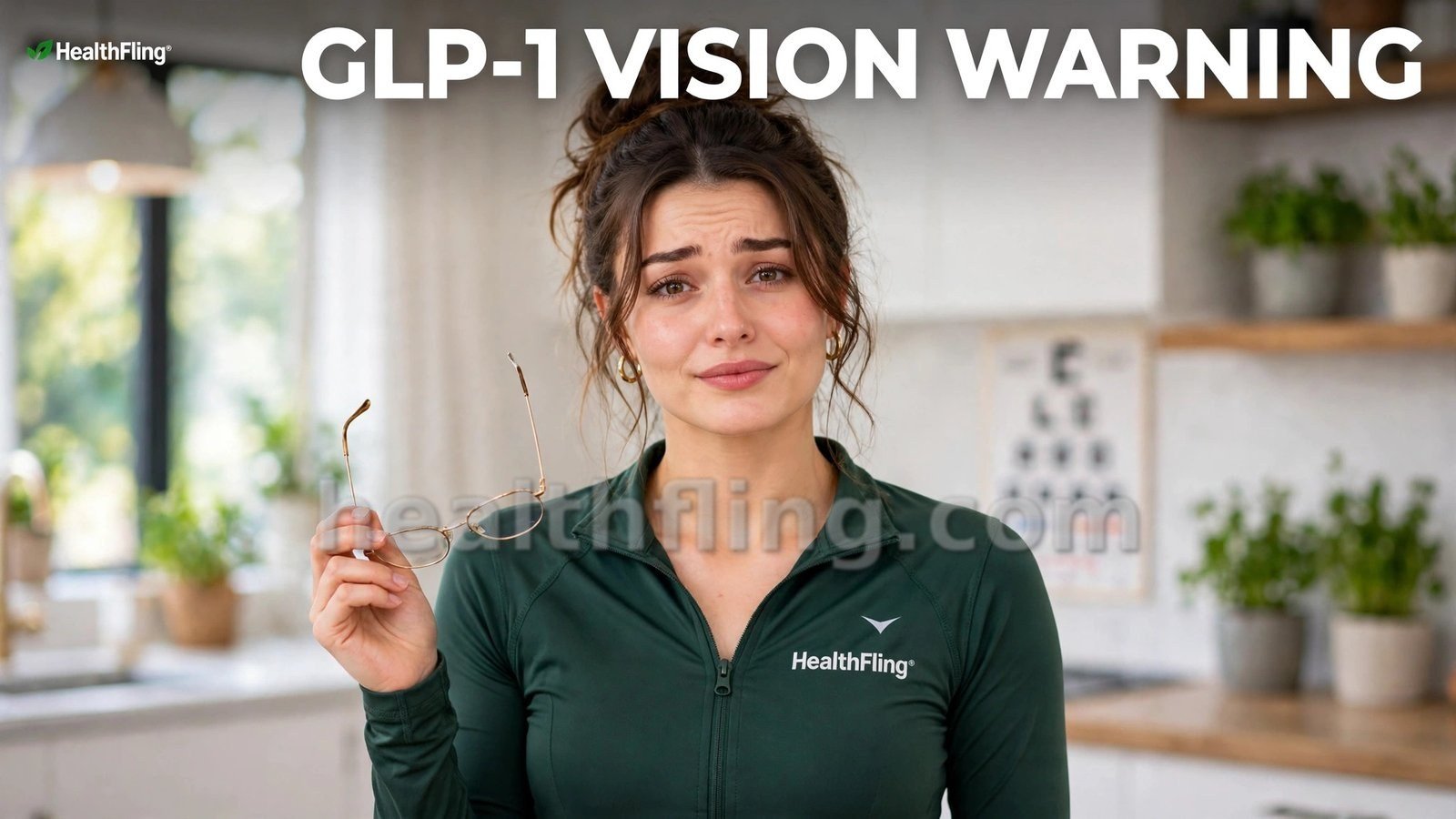
If you take Ozempic, Wegovy, Mounjaro or Zepbound, the box your medicine comes in is about to change. A new GLP-1 vision loss warning is being added to the label — and this week, the two companies behind these drugs confirmed they are preparing to put it there.
The warning is about a rare eye condition called NAION — non-arteritic anterior ischemic optic neuropathy. Doctors sometimes call it an “eye stroke.” It happens when blood flow to the optic nerve is suddenly reduced, and it can cause vision loss without pain, usually in one eye. In some cases the loss is permanent. That is the condition at the centre of the GLP-1 vision loss warning.
On 9 November 2026, the US Food and Drug Administration (FDA) ordered the makers of every GLP-1 drug sold in America to add a “potential increased risk” of NAION to the Warnings and Precautions section of their labels. The whole class — semaglutide, tirzepatide, liraglutide, dulaglutide and the rest — because NAION cases have been reported with every GLP-1 product on the market. This week Novo Nordisk and Eli Lilly confirmed they are preparing the new labels, and Lilly has already updated its prescribing information. The final updated labels are expected early in 2027.
Now the question every woman on these drugs is asking about the GLP-1 vision loss warning: how worried should I actually be? The honest answer starts with the numbers, because they tell a very different story from the headlines.
The FDA based its decision on a pooled analysis of 126 randomised clinical trials covering more than 134,000 patients. Across all of those trials, researchers found just 15 probable cases of NAION — 10 in people taking a GLP-1 and five in people taking a placebo. That works out at 6.4 cases per 100,000 patient-years on a GLP-1, against 3.8 per 100,000 in the comparison groups. That is roughly one extra case for every 38,000 people taking a GLP-1 for a year. Those are the numbers behind the GLP-1 vision loss warning.
There is also a real scientific argument about whether the drugs cause NAION at all. Studies have produced conflicting results, and people with type 2 diabetes — a huge share of GLP-1 users — already carry a higher risk of vision loss and NAION. That makes it hard to separate the effect of the drug from the effect of the condition it treats. Europe and Britain already require some GLP-1s to warn about NAION. The FDA calls it a “potential increased risk” whose cause is “not completely understood.” That uncertainty is part of why the GLP-1 vision loss warning is worded as a potential risk.
But if the risk is that small, why is this suddenly such a big story? Because behind the label change sits a wave of lawsuits. A handful of cases has grown to more than 7,000 GLP-1 lawsuits in state and federal courts in just three years — most alleging stomach injuries such as stomach paralysis and gallbladder disease. The vision-loss cases are newer and smaller, but growing fast: the federal NAION cases have been consolidated into one proceeding in Philadelphia, MDL No. 3163. It held 21 cases in December 2025; by 2 November 2026 it held 278. The GLP-1 vision loss warning is the very thing these lawsuits say was missing from the label.
One of the people suing is Cilette Mitchell, 64, a bank branch manager from San Diego. She started taking Ozempic to lose weight in 2024 and woke up one morning with clouded vision in her right eye. Within weeks she had lost sight in her other eye too, leaving her legally blind on both sides.
“If I had been informed, I would have never taken this medication, ever,” Mitchell said.
The core claim is simple: the drugmakers knew, or should have known, about the NAION risk and failed to warn patients and doctors. The companies reject that. Novo says it “continues to believe the data do not establish a cause-and-effect relationship” and remains confident in the benefit-risk profile of its GLP-1 medicines. Lilly said it “appreciates the court’s careful consideration of the scientific evidence,” including on causation. Adding the label is not an admission that the drugs cause NAION — the courts will decide that, with key rulings expected around mid-2027. Until then, the GLP-1 vision loss warning stands as the label’s account of the risk.
GLP-1 Vision Loss Warning: What Should You Do?
First, do not stop your medication on your own because of a headline. Suddenly stopping a GLP-1 can bring back appetite, weight and blood sugar problems, and this warning is about a rare risk, not a common one. If you are worried, talk to the doctor who prescribed it — that conversation is the right next step, not a decision to make alone. Ask specifically about the GLP-1 vision loss warning and what it means for you.
Second, know the symptoms, because with NAION speed matters. Sudden vision loss or clouded vision, usually in one eye, usually without pain, is a reason to seek urgent medical care straight away — do not wait to see if it clears up. Tell any eye doctor you see that you are taking a GLP-1 and when you started it. Lawyers bringing these cases argue the warning should also recommend eye exams before and after starting a GLP-1 — their position, not medical guidance, but worth asking your doctor about.
Third, do not confuse this with the eye effects your drug already warns about. Several GLP-1s already carry warnings about temporary blurry vision and worsening diabetic eye disease when blood sugar drops quickly. NAION is different: sudden, usually one-sided, and potentially permanent. Knowing the difference is exactly why the GLP-1 vision loss warning exists.
And keep this in perspective. As many as 30 million Americans now take a GLP-1. When a medicine moves that fast, its safety story is written in public — this is the second major GLP-1 safety development this month alone, after new research on GLP-1 weight loss and mammograms. None of that means the drugs are suddenly unsafe. It means the new GLP-1 vision loss warning is the system working as it should: finding a rare risk, putting it on the label, and letting you decide with your eyes open.
This article is general information only and is not medical advice. If you take a GLP-1 medication and notice any change in your vision, seek medical care immediately. If you have questions about your medication, talk to your doctor or pharmacist.
Frequently Asked Questions
What is NAION?
NAION stands for non-arteritic anterior ischemic optic neuropathy. It happens when blood flow to the front part of the optic nerve drops suddenly, damaging the nerve. It usually causes sudden, painless vision loss in one eye and can be permanent. It is the condition named in the GLP-1 vision loss warning.
How common is NAION with GLP-1 drugs?
Very rare. The FDA pooled 126 clinical trials with more than 134,000 patients and found 15 probable cases — 6.4 per 100,000 patient-years on a GLP-1 versus 3.8 per 100,000 in comparison groups. Roughly one extra case per 38,000 people treated for a year. That is the scale of risk behind the GLP-1 vision loss warning.
Should I stop taking my GLP-1 because of the GLP-1 vision loss warning?
No — not on your own. The FDA has stressed that the benefits of these drugs outweigh the risks when used as directed. If you are concerned, speak to the doctor who prescribed your medication.
What are the GLP-1 vision loss lawsuits about?
Patients who developed NAION after taking a GLP-1 are suing Novo Nordisk and Eli Lilly, claiming the companies failed to warn about the risk. The federal cases — 278 as of 2 November 2026 — are consolidated in Philadelphia as MDL No. 3163. The courts have not decided if the drugs cause NAION; key rulings are expected around mid-2027.
Sources
- The Straits Times (Bloomberg), “Novo Nordisk, Eli Lilly to add warning labels to GLP-1s amid wave of vision-loss lawsuits,” 25 November 2026 — label preparations, 7,000+ lawsuits, 278 NAION cases in MDL No. 3163, Cilette Mitchell’s story, company statements. Read the report
- USA TODAY, “FDA says popular GLP-1 drugs linked to rare risk of vision loss, blindness,” 9 November 2026 — FDA Drug Safety Communication; 126 trials, 134,253 patients, 15 probable NAION cases, 6.4 vs 3.8 per 100,000. Read the USA TODAY report
- Drugs.com MedNews, “GLP-1 Weight Loss Medications Can Increase Breast Density Seen On Mammograms,” 24 November 2026 — cross-checked GLP-1 context (Gallup 11% vs 3% in 2024; FDA NAION review). Read the Drugs.com report
- Helbock Law / Mass Arbitration, “FDA Orders GLP-1 NAION Warning” (MDL No. 3163 explainer), November 2026 — JPML report of 2 November 2026 (278 pending actions; monthly growth 110 in June to 247 in October); expert reports due March 2027, motions July 2027; EMA listed NAION as a very rare semaglutide side effect in June 2025. Read the MDL explainer