
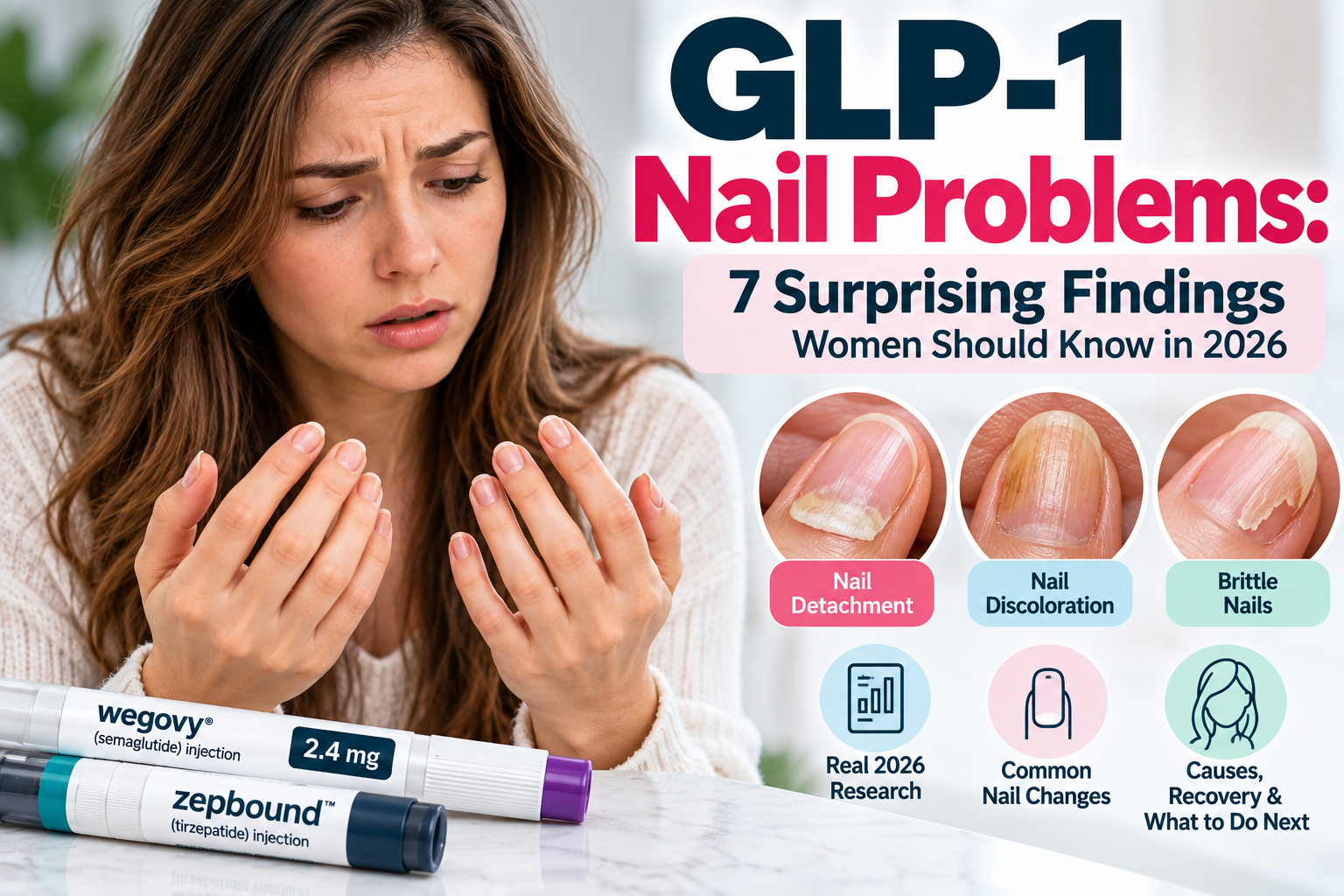
GLP-1 Nail Problems: 7 Surprising Findings Women Should Know in 2026
GLP-1 nail problems are suddenly getting much more attention.
If you take a GLP-1-based medicine such as semaglutide or tirzepatide, you may already know about common concerns involving nausea, appetite changes and hair shedding.
But nails?
That question became much more interesting after fresh research presented at the European Academy of Dermatology and Venereology (EADV) Congress 2026.
Researchers compared 575 GLP-1 users with 1,329 people with obesity and/or type 2 diabetes who had never used the medicines.
They reported that nail detachment occurred in 39% of GLP-1 users versus 9% of controls, while nail discoloration affected 46% versus 17%.
Overall, 66% of GLP-1 users reported at least one nail disorder compared with 53% of controls. EADV
You can review the official EADV Congress 2026 research release.
Those numbers sound dramatic.
But they need careful interpretation.
This was a cross-sectional, patient-reported study presented at a scientific congress, not a randomized trial designed to prove that GLP-1 medicines directly damage nails.
Around half of GLP-1 users reported that some nail problems had existed before treatment. Researchers also found that adjusting for dermatological conditions and nutritional deficiencies weakened some associations.
Still, nail detachment and discoloration remained around two to three times more frequent after adjustment. EADV
Here are seven important things women should know about GLP-1 nail problems in 2026.
What Are GLP-1 Nail Problems?
GLP-1 nail problems can include changes such as nail lifting or detachment, discoloration, brittleness or other nail abnormalities reported during GLP-1 treatment.
The strongest fresh signal from the EADV Congress study involved:
- nail detachment
- nail discoloration
- overall nail disorders
Researchers have not yet proved that GLP-1 medicines directly cause these changes.
Possible explanations may include medication effects, nutritional changes, existing dermatological conditions, weight loss or a combination of factors.
That distinction is important.
1. Nail Detachment Was More Than Four Times as Common
The most attention-grabbing result involved nail detachment, also known medically as onycholysis when the nail plate separates from the nail bed.
In the 2026 EADV study:
39% of GLP-1 users reported nail detachment compared with 9% of controls. EADV
That is more than a fourfold difference in the unadjusted comparison.
The study is important because previous information about GLP-1 nail problems had largely come from isolated reports rather than controlled comparisons.
But the number should not be interpreted as:
“39% of everyone taking Wegovy or Zepbound will lose a nail.”
The participants were selected research groups, symptoms were self-reported, and many users had nail problems before treatment.
The finding is a signal that deserves further study, not a guaranteed outcome for an individual patient.
2. Nail Discoloration Was Also Reported More Often
Nail detachment was not the only difference.
The EADV researchers reported nail discoloration in 46% of GLP-1 users versus 17% of controls. EADV
Nail discoloration can have many causes.
Depending on the appearance, possibilities can include:
- fungal infection
- trauma
- nail polish staining
- inflammatory skin disease
- medication effects
- nutritional factors
- other medical conditions
That means a color change should not automatically be blamed on a GLP-1 medicine.
A dermatologist can often distinguish between drug-related changes and other common nail problems.
The American Academy of Dermatology advises people using GLP-1 drugs to discuss new skin, hair or nail side effects with their medical team rather than trying to diagnose the cause themselves. (aad.org) AAD
3. Weight Loss Alone Did Not Explain the Findings
This may be the most scientifically interesting part of the study.
You might assume that GLP-1 nail problems occur simply because someone is losing weight quickly or eating much less.
Nutrition may certainly matter.
But researchers found that the differences in nail problems remained significant even when they focused specifically on participants who had lost weight. EADV
That suggests weight loss alone may not fully explain the association.
The researchers also adjusted for some dermatological conditions and nutritional deficiencies.
After those adjustments, nail detachment and discoloration were still around two to three times more frequent among GLP-1 users. EADV
That does not prove a direct medication effect.
But it gives researchers a reason to investigate other possible mechanisms.
4. The Study Does Not Prove GLP-1 Drugs Cause Nail Damage
This limitation is essential.
The 2026 nail study was cross-sectional and relied on patient-reported symptoms.
That type of study can find an association, but it cannot prove that one factor caused the other.
The EADV researchers specifically cautioned that not everything happening during GLP-1 treatment is necessarily caused by the medicine itself. EADV
Around half of users reported nail issues that existed before starting treatment.
That means some cases may reflect:
- pre-existing nail disease
- fungal infection
- trauma
- nutritional deficiency
- psoriasis or eczema
- diabetes-related nail changes
- another medication
- other health conditions
So the correct message is not:
“GLP-1 medicines make your nails detach.”
A more accurate conclusion is:
New research found GLP-1 users reported nail detachment and discoloration more often than comparable non-users, but researchers have not yet established why.
That is how HealthFling will report GLP-1 nail problems without exaggerating the evidence.
5. Reduced Food Intake Could Still Affect Nail Health
Although weight loss did not completely explain the study results, nutrition remains relevant.
GLP-1 treatments can substantially reduce appetite.
If someone begins eating far less, it may become harder to consume enough:
- protein
- iron
- zinc
- vitamin B12
- folate
- healthy fats
- total energy
Nails are made primarily from keratin, a protein.
That does not mean simply eating huge amounts of protein will prevent every nail problem.
But adequate overall nutrition matters for normal tissue growth.
The American Academy of Dermatology also notes that GLP-1 treatment can reduce food intake and may affect how much protein, vitamins and other nutrients a person consumes. AAD
If your appetite is very low, focus on making the food you do eat nutritionally useful.
For a general educational estimate, use the HealthFling Protein Calculator.
You can also estimate your energy needs with the HealthFling Calorie Calculator.
If you are also experiencing shedding, read GLP-1 Hair Loss: 7 Important Facts Women Should Know in 2026.
6. Nail Detachment Should Not Simply Be Ignored
A nail that starts separating from the nail bed deserves attention.
Once part of the nail has lifted, the exposed area can become more vulnerable to:
- trauma
- irritation
- moisture
- debris
- infection
Do not try to glue the nail back down.
Avoid aggressively cleaning underneath it with sharp objects.
And do not assume every case is cosmetic.
A dermatologist can check whether the problem is related to:
- onycholysis
- fungal infection
- psoriasis
- trauma
- medication
- another nail disorder
The EADV researchers emphasized that patients who notice nail changes should mention them to their doctor rather than stopping treatment on their own. EADV
That is especially important when GLP-1 nail problems appear alongside pain, redness, swelling or signs of infection.
7. Do Not Stop Wegovy, Ozempic or Zepbound on Your Own
The researchers behind the EADV findings were clear about this point.
Their results were intended to create awareness, not alarm.
They specifically advised people noticing hair, scalp or nail changes to discuss the symptoms with a doctor rather than discontinuing effective therapy on their own. EADV
That matters because GLP-1 medicines may be prescribed for important medical reasons, including obesity and type 2 diabetes.
The decision to continue, change or stop treatment should consider:
- why the medicine was prescribed
- how well it is working
- the severity of the nail problem
- other possible causes
- nutritional status
- other side effects
- alternative treatment options
For readers also researching medication-specific hair effects, see:
Does Wegovy Cause Hair Loss? 7 Facts Women Should Know in 2026
and
Does Zepbound Cause Hair Loss? 7 Important Facts Women Should Know in 2026
These articles help strengthen HealthFling’s broader GLP-1 side-effects cluster without targeting the same search intent.
What Does Nail Detachment Look Like?
Nail detachment can appear as the nail plate lifting away from the skin underneath.
You might notice:
- a white or pale area extending from the tip of the nail
- an increasing gap beneath the nail
- changes in nail color
- the nail feeling loose
- debris collecting underneath
- tenderness in some cases
Not every lifted nail is caused by medication.
Repeated trauma, long nails, manicures, fungal infection and skin diseases can also cause separation.
That is why diagnosis matters.
Are GLP-1 Nail Problems Permanent?
We do not yet know.
The EADV investigators said prospective studies are planned to follow people from the start of GLP-1 treatment using standardized dermatology examinations and biological monitoring.
The goal is to understand:
- when nail changes begin
- why they happen
- which patients are most vulnerable
- whether the changes reverse
- whether treatment affects recovery
Because those studies have not yet been completed, it would be misleading to promise that all GLP-1 nail problems are temporary.
It would also be misleading to assume they are permanent.
The evidence is still evolving. EADV
What Should You Do If Your Nails Change on a GLP-1?
Tell Your Prescriber
Mention when the nail change began and whether it started before or after GLP-1 treatment.
Also explain whether you recently lost a large amount of weight or dramatically changed your diet.
Consider a Dermatologist
A dermatologist can examine the nail and help distinguish medication-related changes from fungal infections, psoriasis, trauma or other conditions.
The AAD recommends working with a board-certified dermatologist when GLP-1 users experience persistent skin, hair or nail effects. AAD
Keep Nails Short and Protected
Long nails may be easier to catch or traumatize if they are already lifting.
Keeping them reasonably short and avoiding repeated trauma may help protect the area.
Avoid Aggressive Manicures
If the nail is separating or damaged, avoid filing aggressively underneath the nail or repeatedly covering a worsening problem with cosmetic products.
Review Your Nutrition
If your appetite has fallen dramatically, make sure your weight-loss strategy is not becoming an extreme starvation-style diet.
The HealthFling Protein Calculator can provide a general protein estimate.
For a more sustainable approach to daily habits, explore the HealthFling 30-Day Journey.
GLP-1 Nail Problems vs GLP-1 Hair Loss
The same EADV research program also examined hair and scalp symptoms.
In the companion study, unusual hair loss was reported by 50% of GLP-1 users versus 34% of controls, while loss of hair density or volume was reported by 42% versus 19%. Hair loss beginning after treatment initiation was reported in 26% versus 12%. EADV
The researchers noted that scalp symptoms such as redness, itching and scaling often accompanied hair loss.
This raises the possibility that the hair and nail findings may involve more than weight loss alone.
For a complete explanation, read the HealthFling pillar guide:
GLP-1 Hair Loss: 7 Important Facts Women Should Know in 2026.
Frequently Asked Questions About GLP-1 Nail Problems
Are GLP-1 Nail Problems a Proven Side Effect?
New 2026 research found a strong association between GLP-1 use and certain nail disorders, particularly nail detachment and discoloration.
However, the study was cross-sectional and patient-reported, so it cannot prove direct causation. EADV
How Common Was Nail Detachment in the 2026 Study?
Nail detachment was reported by 39% of GLP-1 users compared with 9% of controls in the multinational EADV Congress study. EADV
How Common Was Nail Discoloration?
Nail discoloration was reported by 46% of GLP-1 users compared with 17% of controls. EADV
Does Rapid Weight Loss Cause GLP-1 Nail Problems?
Weight loss may contribute to nutritional changes, but the 2026 study found differences in nail disorders remained even among participants who had lost weight.
This suggests weight loss alone may not fully explain the association. EADV
Can Wegovy Cause Nail Problems?
The 2026 study examined GLP-1 receptor agonists as a group rather than proving a specific nail effect for every individual brand.
If you develop nail symptoms while using Wegovy, discuss them with your prescriber or dermatologist rather than assuming the medication is definitely responsible.
Can Zepbound Cause Nail Problems?
The same caution applies to tirzepatide-based treatment.
Current evidence supports a broader GLP-1-treatment association with nail disorders, but it does not establish that every individual nail problem is directly caused by Zepbound.
Should I Stop My GLP-1 If My Nail Starts Lifting?
Do not stop a prescription medicine based solely on an online article.
The EADV study authors advised patients with nail or hair changes to discuss them with their doctor rather than discontinue treatment on their own. EADV
The Bottom Line
GLP-1 nail problems are becoming an important new research topic.
Fresh findings presented at the EADV Congress 2026 found that GLP-1 users reported:
- nail detachment more often than controls
- nail discoloration more often than controls
- more overall nail disorders
The strongest headline result was 39% nail detachment among users versus 9% among controls. EADV
But these findings should not be turned into a scare story.
The study does not prove that GLP-1 medicines directly cause every nail problem.
Some participants had nail disorders before treatment, nutritional factors and skin conditions may contribute, and prospective research is still needed.
The practical message is simple:
Notice changes, protect damaged nails, review your nutrition and talk to your healthcare professional rather than stopping medication on your own.
For broader GLP-1 side-effect coverage, read:
GLP-1 Hair Loss: 7 Important Facts Women Should Know in 2026
Does Zepbound Cause Hair Loss?
You can also explore the HealthFling Free Health Tools for practical weight-management resources.
HealthFling provides general educational information and is not a substitute for individualized medical advice. Speak with a qualified healthcare professional about nail changes, possible medication side effects, nutritional deficiencies or changes to prescribed GLP-1 treatment.
Trusted Research Sources
European Academy of Dermatology and Venereology — 2026 GLP-1 Nail Study
European Academy of Dermatology and Venereology — EADV Congress 2026
American Academy of Dermatology — GLP-1 Hair, Skin and Nail Guidance