
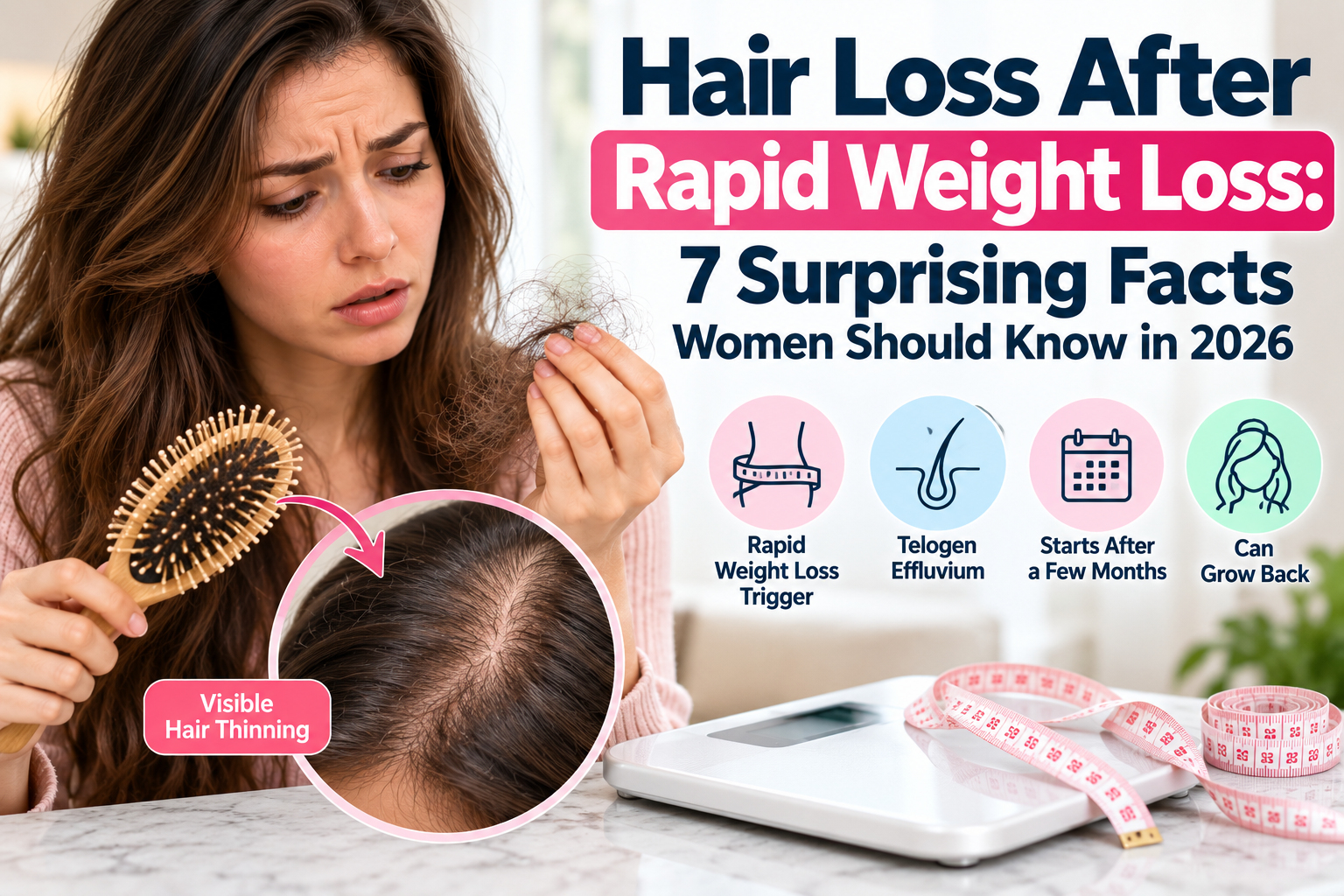
Hair Loss After Rapid Weight Loss: 7 Surprising Facts Women Should Know in 2026
Hair loss after rapid weight loss can feel frightening.
You work hard to lose weight, begin feeling healthier or more confident — and then suddenly there seems to be hair everywhere.
More strands in the shower.
Hair wrapped around your brush.
A thinner ponytail.
More scalp showing through your hair.
What makes the experience especially confusing is that the shedding may begin weeks or months after the weight loss started.
One common explanation is a temporary shedding condition called telogen effluvium.
The British Association of Dermatologists lists marked weight loss and extreme dieting among recognized triggers of telogen effluvium and explains that increased shedding can appear around three months after the triggering event. (bad.org.uk)
The American Academy of Dermatology also identifies major weight loss as a trigger for excessive hair shedding and notes that the shedding often becomes noticeable months after the stressful event. (aad.org)
So hair loss after rapid weight loss is not necessarily a sign that your hair follicles have been permanently damaged.
Here are seven important facts women should know.
What Causes Hair Loss After Rapid Weight Loss?
Hair loss after rapid weight loss is often linked with telogen effluvium, a temporary disruption of the normal hair-growth cycle. Significant weight loss, severe calorie restriction, physical stress and nutritional deficiencies may push more hairs into the resting phase, leading to increased shedding several months later.
But rapid weight loss is not the only possible cause.
Other conditions can look similar, including:
- iron deficiency
- thyroid disease
- female-pattern hair loss
- hormonal changes
- illness
- major stress
- medications
- scalp disease
That is why persistent or unusual hair loss deserves proper evaluation.
1. Hair Shedding Can Begin Months After the Weight Loss
This delayed timing surprises many people.
Hair grows in cycles.
The British Association of Dermatologists explains that when telogen effluvium occurs, a larger-than-normal proportion of hair follicles move into the resting or shedding phase.
Those hairs do not necessarily fall out immediately.
The visible shedding can occur around three months after the trigger. (bad.org.uk)
Imagine this timeline:
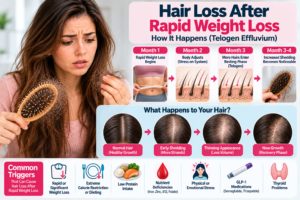
Month 1: You begin losing weight rapidly.
Month 2: Your weight continues dropping.
Month 3 or 4: Suddenly, much more hair appears in the shower or brush.
By then, you may not connect the hair problem with the earlier period of rapid weight loss.
This delayed response is one reason hair loss after rapid weight loss can feel as though it appeared without warning.
2. Telogen Effluvium Usually Causes Diffuse Shedding
Hair loss comes in different patterns.
Telogen effluvium generally causes diffuse shedding across the scalp rather than one sharply defined bald patch.
You may notice:
- more hair while washing
- more hair during brushing
- strands on your pillow
- reduced overall hair volume
- a smaller ponytail
- more visible scalp
The British Association of Dermatologists says people often notice decreased hair thickness and volume rather than isolated patches. (bad.org.uk)
That distinction matters.
A smooth bald patch, significant scalp inflammation or strongly patterned thinning may point toward a different diagnosis.
3. Extreme Dieting May Increase the Risk
Losing weight and crash dieting are not necessarily the same thing.
A medically appropriate calorie deficit can be part of healthy weight management.
But extreme restriction may create additional physical stress.
The British Association of Dermatologists specifically lists both marked weight loss and extreme dieting among telogen effluvium triggers. (bad.org.uk)
That means trying to lose weight as fast as possible may not always be the smartest strategy.
If calorie intake drops dramatically, it can also become harder to consume enough:
- protein
- iron
- zinc
- vitamin B12
- folate
- healthy fats
- total energy
Nutrition does not explain every case of hair loss after rapid weight loss, but it is one factor worth considering.
For a general estimate of your energy needs, try the HealthFling Calorie Calculator.
For a general protein estimate, use the HealthFling Protein Calculator.
These tools are educational and do not replace individualized medical or dietetic advice.
4. GLP-1 Weight-Loss Treatment Can Be Part of the Picture
The explosion in GLP-1 weight-loss treatment has made this topic even more relevant.
Medicines such as semaglutide and tirzepatide can produce substantial weight loss for some patients.
A 2026 meta-analysis involving 4,114 GLP-1 users across nine interventional studies found a significantly higher risk of hair loss compared with placebo and an overall hair-loss event rate of about 3.9%. (pubmed.ncbi.nlm.nih.gov) PubMed
However, researchers still do not know how much of the association comes from:
- the medicine itself
- rapid weight loss
- lower calorie intake
- nutritional insufficiency
- hormonal changes
- individual susceptibility
A 2026 clinical review concluded that the evidence is strongest for semaglutide and tirzepatide, while emphasizing that direct causality has not yet been established. Rapid weight loss remains one proposed explanation. (pubmed.ncbi.nlm.nih.gov) PubMed
For the complete drug-specific cluster, read:
GLP-1 Hair Loss: 7 Important Facts Women Should Know in 2026
Does Wegovy Cause Hair Loss? 7 Facts Women Should Know in 2026
Does Zepbound Cause Hair Loss? 7 Important Facts Women Should Know in 2026
5. Nutrition Matters — But Random Supplements Are Not the Answer
When appetite becomes very low, nutrition can suffer.
The American Academy of Dermatology notes that people taking GLP-1 medications may eat less protein, vitamins and other nutrients needed to support healthy hair growth. (aad.org) AAD
The British Association of Dermatologists recommends a balanced diet including foods rich in protein, iron, fruit and vegetables for people experiencing telogen effluvium. (bad.org.uk)
That does not mean every person with hair loss after rapid weight loss should immediately start:
- high-dose iron
- zinc
- selenium
- biotin
- vitamin A
- multiple hair supplements
Hair loss has many causes.
The smarter approach is to identify whether a deficiency actually exists.
If you are struggling to eat enough during weight loss, discuss it with your healthcare professional or registered dietitian.
6. Hair Can Grow Back After Telogen Effluvium
This is often the biggest concern:
Will my hair come back?
In many cases of telogen effluvium, yes.
The British Association of Dermatologists says telogen effluvium usually gets better without specific treatment.
The active shedding phase generally lasts about three to six months.
After that, new hair begins growing, although it can take many additional months for previous density and volume to return. (bad.org.uk) Bad
That means recovery can feel slow.
New growth may be happening even before your hair looks “normal” again.
However, if hair loss after rapid weight loss continues beyond the expected period, another condition may be contributing.
7. Not Every Case Is Telogen Effluvium
Rapid weight loss can trigger shedding.
But assuming every case is temporary telogen effluvium can also be a mistake.
Other possible causes include:
Iron Deficiency
Low iron stores can contribute to hair shedding in some people.
Thyroid Disorders
Thyroid disease can cause diffuse thinning and may resemble telogen effluvium.
Female-Pattern Hair Loss
Some women already have underlying androgenetic alopecia.
A period of heavy shedding may make the thinning more noticeable.
Alopecia Areata
This autoimmune condition typically produces more clearly defined patches rather than simple diffuse shedding.
Scalp Disease
Inflammation, infection, psoriasis and other scalp conditions may also affect hair growth.
The British Association of Dermatologists notes that blood testing may sometimes be used to exclude conditions such as iron deficiency or thyroid disease. (bad.org.uk)
So if hair loss after rapid weight loss is severe, persistent or unusual, diagnosis matters.
How Much Hair Shedding Is Too Much?
Normal shedding happens every day.
The exact number varies from person to person.
More important than counting every strand is noticing a significant change from your usual pattern.
Common clues include:
- shower drains filling much faster than usual
- large amounts on your brush
- visible loss of density
- a noticeably smaller ponytail
- scalp becoming easier to see
The American Academy of Dermatology distinguishes excessive shedding from other forms of true hair loss and notes that telogen effluvium often follows a significant stressor or body change. (aad.org) AAD
How Can You Reduce Hair Stress While Losing Weight?
There is no guaranteed way to prevent telogen effluvium.
But several practical steps may help reduce avoidable stress.
Avoid Crash Dieting
A plan that promises extremely rapid weight loss may also be difficult to sustain.
Aim for a medically appropriate strategy rather than trying to eat as little as possible.
Eat Enough Protein
Protein supports many tissues throughout the body.
Use the HealthFling Protein Calculator for a general estimate.
Include Iron-Rich Foods
Examples include:
- lean meat
- lentils
- beans
- leafy green vegetables
- fortified foods
Do not start high-dose iron unless a healthcare professional determines it is appropriate.
Treat Hair Gently
The British Association of Dermatologists recommends:
- avoiding harsh brushing
- limiting heated styling tools
- avoiding harsh chemical treatments
- limiting tight hairstyles
Build Sustainable Habits
The goal of weight management should not be to survive an extreme diet for a few weeks.
For a structured habit approach, explore the HealthFling 30-Day Journey.
You can also add gentle movement with Walking for Weight Loss.
When Should You See a Doctor or Dermatologist?
Seek professional advice if:
- shedding is severe
- it continues beyond several months
- you develop bald patches
- your scalp is painful or inflamed
- hair is breaking rather than shedding from the root
- you feel unusually weak or fatigued
- your diet has become extremely restricted
- you suspect iron or thyroid problems
- hair loss is causing significant distress
The American Academy of Dermatology recommends identifying the exact type of hair loss rather than assuming every case has the same cause. (aad.org)
Hair Loss After Rapid Weight Loss vs GLP-1 Hair Loss
These two topics overlap, but they are not identical.
Hair loss after rapid weight loss can happen whether someone loses weight through:
- dietary changes
- bariatric surgery
- illness
- medication
- GLP-1 treatment
- another major lifestyle or medical change
GLP-1-related hair loss is more specific.
With GLP-1s, researchers are still determining how much of the signal is caused by the medication itself versus the magnitude and speed of weight loss.
Recent 2026 literature continues to identify telogen effluvium as one of the main patterns being studied. PubMed
For GLP-1-specific nail changes as well, read GLP-1 Nail Problems: 7 Surprising Findings Women Should Know in 2026.
Frequently Asked Questions About Hair Loss After Rapid Weight Loss
Is Hair Loss After Rapid Weight Loss Normal?
It can occur.
Marked weight loss is a recognized trigger for telogen effluvium, which causes temporary increased shedding after the hair-growth cycle is disrupted. (bad.org.uk)
How Soon Does Hair Loss Start After Rapid Weight Loss?
Telogen effluvium commonly becomes noticeable around three months after the triggering event, although individual timing varies. (bad.org.uk)
How Long Does Hair Loss After Rapid Weight Loss Last?
If telogen effluvium is responsible, the shedding phase often lasts approximately three to six months.
Full recovery of hair volume can take longer. (bad.org.uk)
Will My Hair Grow Back?
In typical telogen effluvium, new hair generally begins growing after the shedding phase.
If thinning persists, another form of hair loss may also be present.
Does Losing Weight Too Fast Cause Hair Loss?
Rapid or marked weight loss is a recognized telogen effluvium trigger.
That does not mean every person who loses weight quickly will experience shedding.
Can Low Protein Cause Hair Shedding?
Inadequate nutrition, including insufficient protein, may contribute to hair problems.
But protein deficiency is not the only cause of shedding.
Should I Stop a GLP-1 Medicine if My Hair Is Falling Out?
Do not stop a prescribed medication solely because of an online article.
Talk with the clinician who prescribed it and consider dermatology evaluation to determine the type and possible cause of hair loss.
The Bottom Line
Hair loss after rapid weight loss can be alarming, but in many cases the explanation is temporary telogen effluvium.
Marked weight loss, extreme dieting and other major stresses on the body can disrupt the normal hair cycle.
The shedding may not appear until around three months after the trigger, which can make the connection difficult to recognize.
In typical telogen effluvium, the shedding phase often lasts about three to six months and new growth follows, although restoring previous hair density can take longer. (bad.org.uk)
But not every case of hair loss after rapid weight loss has the same cause.
Iron deficiency.
Thyroid disease.
Female-pattern hair loss.
Medication effects.
Scalp disease.
And other health conditions may also contribute.
The best approach is not panic or extreme supplementation.
Focus on sustainable weight management, adequate nutrition, gentle hair care and appropriate medical evaluation when shedding is severe or persistent.
For more tools and evidence-based weight-management guidance, explore the HealthFling Free Health Tools.
HealthFling provides general educational information and is not a substitute for medical diagnosis or individualized treatment. Speak with a qualified healthcare professional about significant hair loss, nutritional deficiencies, rapid weight changes or prescribed medication.
Trusted Research Sources
British Association of Dermatologists — Telogen Effluvium
American Academy of Dermatology — Hair Loss or Hair Shedding?
American Academy of Dermatology — GLP-1 Effects on Hair, Skin and Nails